
Lu Jun: A Small-Scale Production with Great Heart — An Immersive Cultural Tourism Drama Not to Be Underestimated
 76
76 2026-08-08
Coming to Qianshan has put me in a wonderful mood. After watching last night’s performance, I felt especially delighted and deeply gratified. I was moved, reflective, and thankful for the decisions made by the municipal Party committee and government, for the dedication of the creative team, and for the overwhelming enthusiasm of the citizens who filled the venue.
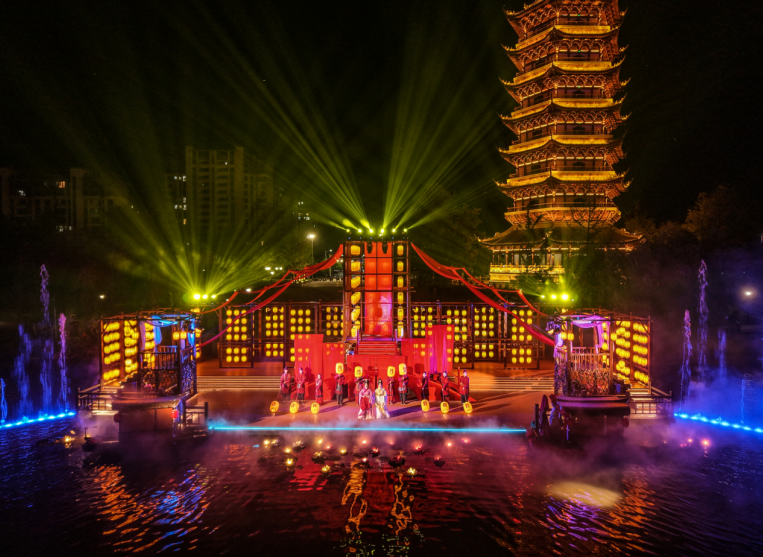
These are my thoughts after watching the premiere of the large-scale immersive cultural tourism production Lakebound Dreams: Xiao Qiao’s Wedding.
I would summarize this work with four “strengths.”
First, the subject matter is excellent. Xiao Qiao is a daughter of Qianshan. She is both a local cultural symbol and a figure with national recognition. She carries deep historical resonance while also allowing room for contemporary interpretation. Choosing such a subject reflects the creators’ vision and sense of responsibility.
Second, the concept is excellent. From the script, direction, and performances to the stage design, music, lighting, and multimedia effects, the overall conception is complete and skillfully structured. In particular, the incorporation of Huizhou-style architecture, Huangmei Opera elements, and the folk customs and local life of Anhui demonstrates the creators’ ingenuity.
Third, the presentation is excellent. The entire production unfolds with smoothness and vitality. It makes full use of the existing landscape and maximizes the strengths of a scenic performance. Most notably, it successfully shapes a major dramatic sequence and gives a vivid portrayal of Xiao Qiao as a character. That is especially difficult to achieve.
Fourth, the guiding philosophy is excellent — and this is the most important point. In implementing the spirit of the central government’s Three-Year Action Plan for the Revitalization of Theatre, this project offers four valuable examples.
First, the central policy calls for artists to “write what they truly wish to write and perform what they do best.” I believe that telling the story of Xiao Qiao through Huangmei Opera melodies, and using that form to tell both China’s story and Anhui’s story well, is a shared aspiration of the people of Qianshan.
Second, the central policy explicitly opposes oversized productions. This work proves through practice that a small-budget project can still become a major work. What matters is strong content and effective creativity. In that sense, it fully aligns with the action plan’s call for frugality and its rejection of superficial extravagance.
Third, the central policy encourages the expansion of new performance spaces and the empowerment of theatre creation and communication through technology. This production steps out of the conventional theater and performs on real waters and shorelines, achieving an integrated viewing experience between boat and bank. It is a bold expansion of new performance space. At the same time, its use of lighting, projection, and electrical stage technologies offers a meaningful exploration of how technology can empower theatre.
Fourth, the central policy calls for stronger collaboration between schools and performing troupes, and between educational institutions and local communities. The success of this work would not have been possible without the close cooperation among schools, local authorities, and professional companies. It is the result of integrated resources and complementary strengths.
Beyond these four strengths, the production also raises three questions worthy of deeper reflection.
First, must cultural tourism theatre and scenic performances always require major investment? The answer is no. The key lies in creativity, in content, and in deep excavation and creative transformation of local culture.
Second, must immersive scenic performances focus only on spectacle and therefore be unable to shape compelling characters? This production offers a new answer: both can be achieved at once. It can be visually impressive and emotionally moving. The landscape serves the character, and the spectacle serves the emotion.
Third, every place has its own cultural symbols, and traditional culture contains people and stories that are deeply moving and still meaningful today. In the context of telling China’s story well and building cultural confidence, how can we communicate them more vividly and effectively? This production begins with a local cultural symbol, connects a historical figure with contemporary values, and offers a path well worth learning from.
About Lu Jun
Lu Jun is a Research Fellow at the Shanghai Research Institute of Culture and History, Director of the Academic Committee of Shanghai Theatre Academy, Director of the Academic Committee of its Institute of Marxism, a second-grade professor, and a doctoral supervisor.
He also serves as Honorary President of the China Theatre Literature Society, Honorary President of the Shanghai Opera Society, and Honorary Chair of the Songjiang District Federation of Literary and Art Circles in Shanghai.
He is recognized as a National Distinguished Teacher under the Ministry of Organization’s Ten Thousand Talents Program, a recipient of the State Council Special Government Allowance, head of the Chinese Playwriting Teaching Team recognized among the third group of Huang Danian-style teaching teams in Chinese universities, a recipient of the First National Advanced Individual Award for Textbook Development, one of the first model workers in the national cultural system, a National Outstanding Teacher, an Outstanding Expert of the Ministry of Culture, an expert in the art disciplines group of the National Textbook Committee for higher education philosophy and social sciences, chief expert twice for major art projects under the National Social Science Fund, and a recipient of more than 30 national honors and projects, including the National Teaching Achievement Award twice, the National Arts Fund three times, national 14th Five-Year Plan textbooks, first-batch national first-class undergraduate courses, the Wenhua Award, and the Cao Yu Script Award.