Liu Efei | Look, Xiao Qiao Has Just Been Married
 88
88 2026-08-12
Look, Xiao Qiao Has Just Been Married
By Liu Efei
Lakebound Dreams: Xiao Qiao’s Wedding has begun! Every evening, as dusk falls, more people gather in Xuehu Park, and Xuehu Pier becomes increasingly lively. Street vendors hurry to set up their stalls, while audiences arriving for the performance busily buy tickets, queue up, and excitedly chat about the highlights they have heard about online or through word of mouth. This is a new cultural tourism project carefully created by Qianshan under the theme “Climb Tianzhu by day, tour Xuehu by night.” With the waters of Xuehu Park as the stage and the beautiful nightscape of the park as the backdrop, visitors are invited to enjoy both scenery and theater at once. After months of careful design, planning, and construction, the large-scale immersive waterborne night-tour performance Lakebound Dreams: Xiao Qiao’s Wedding finally opened in grand style at the end of July.
As the last glow of sunset faded, the park’s streetlights, ground lights, corridor lamps, and decorative lighting gradually lit up one after another, making the already elegant park look even more dazzling. Delighted, I boarded the boat and joined many other visitors on the Tianzhu cruise across the lake. The neon lights flashing along the lakeshore reflected in the rippling water, making the beauty of the lake at night even more enchanting. The boat moved slowly eastward from Xuehu Pier, and the soft moisture of the water, together with the summer evening breeze, drifted gently toward us. With the flowing lights and shimmering lake all around, it felt as if we were traveling through the river of time and crossing a thousand years to experience the legendary love between Xiao Qiao and Zhou Lang.
The moment the bow turned left, we saw water erupting upward on the eastern side of the lake like a white peacock spreading its tail. In an instant, the “peacock screen” unfolded into a fan-shaped water curtain, and images began to appear upon it. We saw the upright majesty of Tianzhushan, a clear spring flowing into Xuehu, the long scroll of six thousand years of ancient Anhui culture, the flames of the Three Kingdoms with warhorses and contending heroes—and of course the delicate face of Xiao Qiao, the heroine of tonight’s dream-play. With light, sound, electricity, water, and mist coming together, we were drawn into “Ripples of Water, Echoes of the Three Kingdoms.”
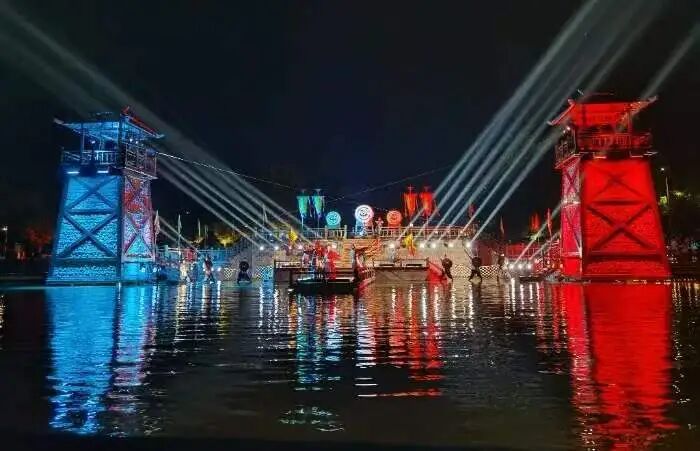
Our boat carried us into the territory of Eastern Wu, where a newly built water fortress stood under the night sky, stern and heavily guarded. Suddenly the lights on the fortress towers flared up, and soldiers were drilling—some sliding on ropes, some rowing boats, others fighting with swords. The clash of weapons and the roaring sounds of military formations were deafening. Then Zhou Yu appeared on the command platform. This young hero of Jiangdong, clad in armor and glowing with youthful vigor, solemnly reviewed the troops and then launched into a martial performance commanding a naval battle. The changing lights from the fortress and city walls, together with towering jets of water and drifting mist, created a stunning effect. Zhou Yu brandished his sword, leapt and turned, and charged with a long halberd. He and the soldiers were all extraordinarily agile, making it feel as if we had entered a blazing battlefield on the water. It was truly shocking.
Since ancient times, talented men have been matched with beautiful women. Lakebound Dreams: Xiao Qiao’s Wedding may well be a retelling of that historical tale in which war and love, might and beauty, moved side by side. The Records of the Three Kingdoms, in the Book of Wu, Biography of Zhou Yu, records: “At that time, he obtained the two daughters of Lord Qiao, both renowned for their beauty. Ce took the elder Qiao, and Yu took the younger Qiao.” (In classical texts, the surname was originally written as Qiao, later commonly rendered as Qiao in fiction and poetry, which is how we know Da Qiao and Xiao Qiao today.) History does not tell us exactly how Zhou Yu and Xiao Qiao met and became husband and wife. So how would this lakeside drama choose to stage their story?
As I was thinking this, a small boat drifted over from the south, accompanied by a soft and beautiful singing voice. One glance made it clear that the young woman in pale green at the bow, playing the zither and singing, must be Xiao Qiao, while the girl in pink beside her, waving a small fan, was her maid. After the song ended, the two exchanged a short conversation:
“Miss, why do you sigh?”
“If only one could choose one’s own fate.”
“What would you choose?”
“I would escape, escape the turmoil of war, and go somewhere with green mountains and clear waters. Build two or three thatched cottages, plant five or six mu of thin fields—just enough to live on.”
“And would there be food for me? I have quite an appetite!”
“You would not be left out.”
“But then who would till the land?”
“There is someone—if his bearing were as beautiful as a painted melody, I would look up to him and follow.”
No sooner had she spoken than another small boat arrived from the north. At its bow stood the handsome young Zhou Yu. Hearing the song and recognizing its spirit, he and Xiao Qiao began to speak. In this way, Xiao Qiao found a kindred soul, and by the bridge they pledged themselves to each other for life. As their boats passed together beneath the bridge arch, the plum blossoms glowing red under the orange lights of the Nine-Arch Bridge lent extra romance to their meeting, while the glittering curtain of water pouring from the bridge overhead added a touch of tenderness to their love born in troubled times. With the lake as the stage, the night as the backdrop, and the small boats as the moving lines of action, it was a marvelous immersive performance. Our own boat then passed through the bridge and headed toward the fourth scene, where a joyful wedding from a thousand years ago gradually came into view: red sails, red drapes, red lanterns, drums and music resounding, lions dancing, neighbors offering congratulations, and soldiers performing celebratory dances. The whole scene was full of festivity.
“Warm Human Fireworks, A Auspicious Night of Celebration.” Then, through changing projections on a screen wall and shifting background staging, we saw the married life of Xiao Qiao and Zhou Yu in harmony, and we saw Xiao Qiao leading villagers in farming, mulberry picking, weaving, and building houses—just as she had once dreamed: two or three thatched cottages, five or six mu of fields. This was not only the great love story of Xiao Qiao and Zhou Lang, but also the story of Xiao Qiao’s growth and transformation. At first, she thought only of her own wishes. Before marriage, she worried whether Zhou Yu, as Grand Commander always away at war, could ever give her the peaceful life she longed for, and feared he might die on the battlefield. Later, she came to support his campaigns, and even led the local people in farming and weaving to help guard their land. Even when she heard that Cao Cao coveted the fertile lands of Eastern Wu and had sent troops to attack, and when rumors spread outside that she was a “beauty who brings calamity,” shaking military morale, Xiao Qiao thought not of herself but of how to resist the enemy and drive back the invaders. Inspired by Zhou Yu, she matched the heart of the zither with the courage of the sword, supporting the front lines from the rear.
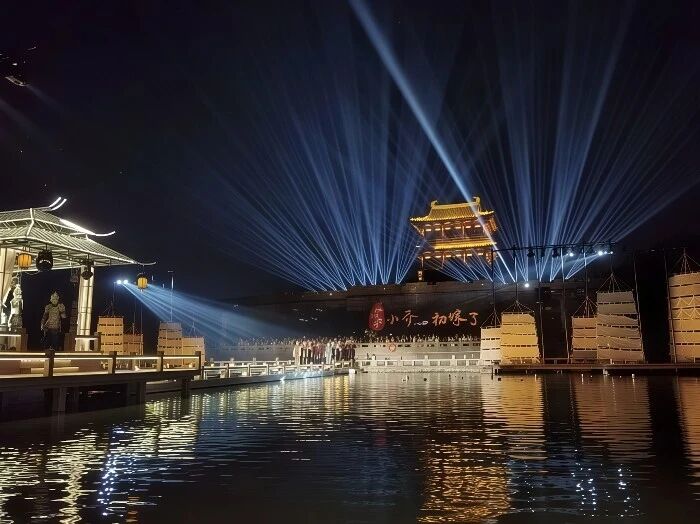
The greatest strength of immersive theater is that the stage itself moves. The boat turned north and arrived at the waters directly in front of Shuwang Pavilion. There we watched the final act: “The Flames of Red Cliffs, a Sword of Love Protecting the Mountains and Rivers.” In an instant, the city wall before Shuwang Pavilion became the battlements of an ancient battlefield, while the cloud-sails hung from eight upright columns seemed to transform into warships. Hatred and grief, blood and tears, flashing blades and drawn swords, separation and death—all were vividly presented through changing lights, projected images on the walls, simulated fire on the sails, and the sounds of combat. It was as if the Battle of Red Cliffs had returned before our eyes. When the war ended, Zhou Yu and Xiao Qiao finally reunited after many hardships and spoke their hearts to each other. Zhou Yu said, “If you do not fail me, I will not fail you.” Xiao Qiao replied, “I wish for abundant harvests, peace for the nation, and safety for the people.”
The drama is brief, but the emotion is long. The plot may seem simple, yet it carries tremendous tension. Xiao Qiao’s name has been familiar to people for nearly eighteen hundred years, but the image of her presented here feels entirely new. The historical Xiao Qiao is distant and indistinct; the Xiao Qiao we see in this production is vivid and alive. She has a maiden’s dream of love and music, a pastoral dream of green mountains and clear waters, and a larger devotion to home and country. She not only dares to dream, but also dares to pursue those dreams. Yet she surely never imagined that more than a thousand years later, people in her hometown would take her story as a model and continue writing a new story of pursuing dreams.
After stepping out of Xiao Qiao’s “dream” and reflecting on the four characters of “touring the lake, playing with dreams,” one naturally understands the designers’ intention of connecting past and present through the idea of dream. Rooted in local culture, they excavate Xiao Qiao’s dreams and dramatize her growth and transformation; they create a stunning dreamscape of immersive lake touring and theater-going; and by weaving Xiao Qiao’s dream into the project itself, they help bring Qianshan’s cultural tourism dream to life.
About the author
Liu Efei is a member of the Qianshan Writers Association and currently works at Meicheng Primary School in Qianshan.