
Niu Wenjia: Presenting a Truly Different Production
 80
80 2026-08-09
Tonight, as I watched the gently rippling lake under the night sky, I could not help thinking back to a spring evening more than a year ago, when my team and I first came to Xuehu for research and inspiration. Before us lay a scene of shimmering water, mountains, and poetic beauty, yet a thousand years ago this place would have echoed with clashing weapons and skies filled with the flames of war. In that moment, Su Shi’s timeless lines came back to me: “I imagine Gongjin in those years, when Xiao Qiao had just been married—heroic and full of youthful brilliance.” From that point on, we began asking ourselves: in the “hometown of the Two Qiaos,” how could we shape Xiao Qiao into a female figure who transcends a thousand years—widely known, and yet carrying both the strength of Anhui’s mountains and the grace of Anhui’s waters?
Our artistic advisor, Professor Lu Jun, put forward a forward-looking idea: without contradicting history, we should interpret the character through a contemporary perspective and reconstruct the historical story through modern theatrical concepts. Our chief director, Professor Lu Ang, creatively proposed the directorial principle of “one body, two sides” to portray the multiple dimensions of Xiao Qiao’s inner world. Under the leadership of executive director Wang Jiajian, a creative team of more than twenty members—including playwrights and lyricists Zhang Chi and Li Ruiyang, visual director Xie Yuxi, dance director Wang Junjie, composer Hong Liu, and opera music consultant Chen Huaqing—embarked on nearly a year of writing, design, and production.
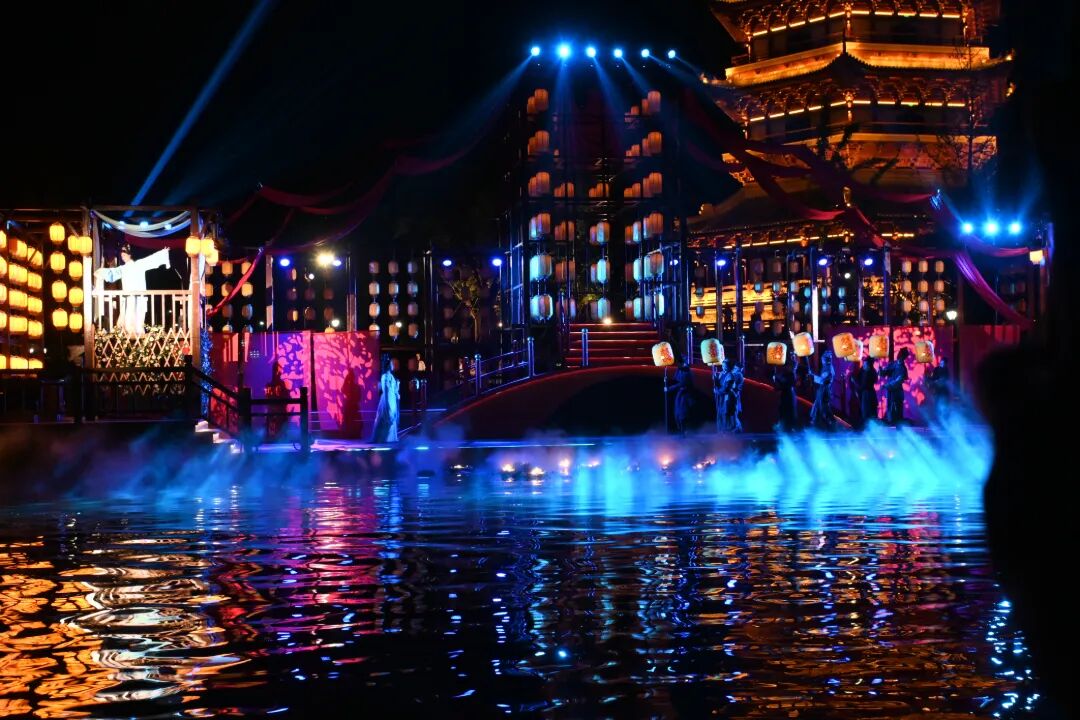
From the very beginning, we wanted to offer Qianshan a production that would be truly different.
That sense of difference first lies in the dramatic structure of the work. We insisted on solid theatrical storytelling, breaking away from the familiar path of many water-based performances that often rely on weak plots, fragmented scenes, and loosely connected spectacle. Faced with vast historical materials, we refused to let Xiao Qiao remain merely a beauty symbol within traditional narratives. Instead, we built for her a complete and powerful female-centered growth arc. We wanted this seemingly delicate and peerless beauty to pass through conflicts of love and resentment, sorrow and longing, life and death, and the tension between self and homeland—until, at the moment of facing the horrors of war, she rises and lets out her cry. Through dramatic tension, we sought to let history illuminate human nature, and to bring grand war narratives back to intimate emotional choices.
This difference also lies in the ingenuity of the spatial staging. We did not undertake large-scale construction; instead, we borrowed scenery from nature itself and from Xuehu. With restraint and craftsmanship, we transformed this naturally beautiful lake into a stage created by the landscape. Relying on Xuehu’s existing pavilions, towers, and cultural architecture, we adapted to local conditions, refined the environment, and connected the spaces seamlessly. Through a progressive water route, we linked together the ten-year love story of Zhou Yu and Xiao Qiao, creating a dreamlike experience in which the boat moves through the water while the viewer travels through a living painting.
This difference is also found in the reinvention of the musical language. Within the texture and framework of musical theater, we organically incorporated the vocal style and expressive charm of Huangmei Opera, allowing Western and Chinese instruments to interact, and blending popular music with Huangmei melodies in a natural way. We reworked nationally familiar Huangmei Opera classics through modulation, choral interpretation, and lyrical deconstruction, creating a distinctive auditory identity within a feeling that is at once familiar and newly strange.
Creation is both joyful and demanding.
About Niu Wenjia
Niu Wenjia is the chief producer and chief writer of the production, founder of Shanghai Reyi Network Technology Co., Ltd., and a Ph.D. graduate of Shanghai Theatre Academy. He has created more than twenty large-scale works in spoken drama, traditional opera, musical theater, and immersive theater, and has been repeatedly invited to create commissioned works for the Shanghai International Arts Festival. His works have received numerous provincial- and ministerial-level honors, including the Outstanding Award in the Shanghai New Repertoire Evaluation and Performance Exhibition, the Outstanding Award in the Anhui Stage Art Script Solicitation, the Outstanding Production Award at the Jiangsu Zijin Culture and Arts Festival, and the Outstanding Case Award for Small-Theater Productions in Jiangsu Province.